Five foundational tools, plus the rest of what has been built. The protocol is open. The chart is the canonical implementation. The diagnostic gives you a score. Everything below is something a real OTP user reaches for in their first week.
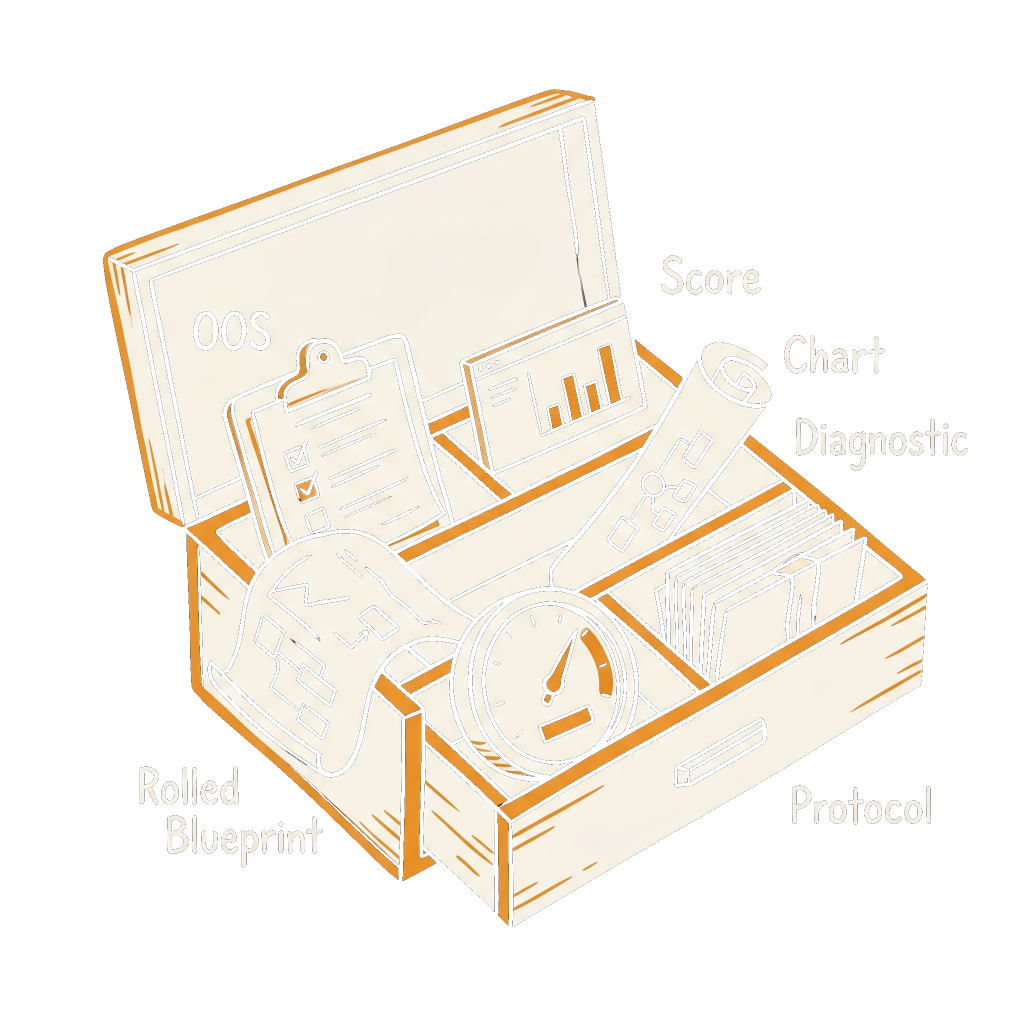
A plain-YAML file you fill in to describe your organization. Entities (humans + agents), claims (rules, patterns, failures), publishable to the network. The same format the canonical OTP chart writes automatically. Use it to learn the shape, then graduate to the live editor.
Live at /dashboard/team. Add humans and AI agents as named seats. Wire reporting and escalation lines by drag. Author SOPs. Track KPIs. Export the inherited CLAUDE.md for any agent. Five Founder/CEO SOP templates seeded so you have a starting point in sixty seconds.
Click any agent tile, hit "Copy as CLAUDE.md," and OTP compiles that agent's own SOPs plus the SOPs of the human it reports to into a single markdown file. Drop it into Claude Code, Cursor, Codex, Aider, or any other stack. The agent now reads its inherited context at every session. Output formats: AGENTS.md, CLAUDE.md, .cursorrules, generic system prompt.
Describe a role. Pick skills and tools. Set a personality framework (DISC, Big Five, MBTI, or skip). The builder drafts a complete agent spec informed by coordination patterns from organizations already running agents in production. Output is a CLAUDE.md you can drop into any stack, or a tile you place directly on your chart.
Score your organization against the 8 Levels of Agentic Maturity. Each level names what is actually happening (or not) at that level. Honest read of where you sit, what is blocking the next level, and what to do this week. Originally built for Bassim, our internal evaluator. Now public.
The fastest way to know whether OTP belongs in your org is to try one tool against one real problem you have right now.