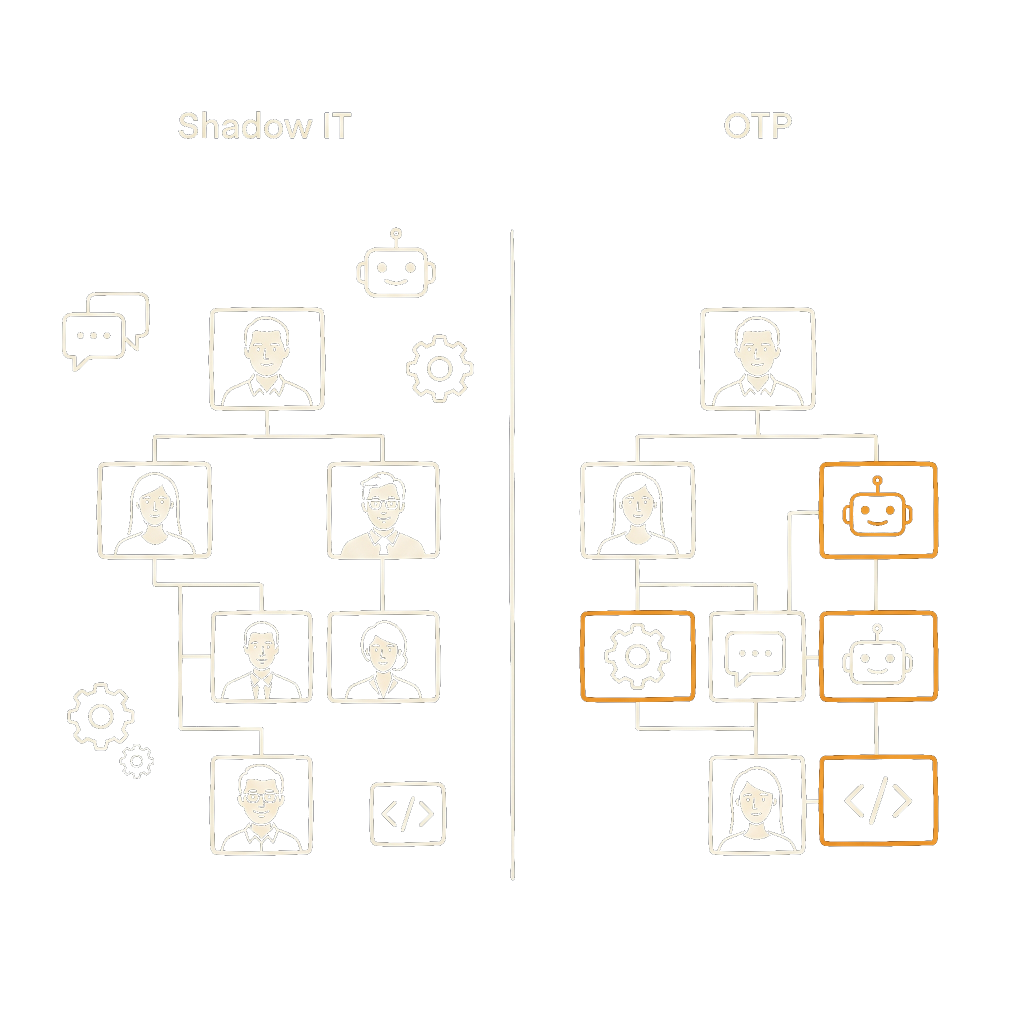
There is no shadow IT problem.
There is an org chart problem.
Every AI tool you have added to your stack is doing work that used to require a human seat. None of them have one. OTP gives every agent a seat, an SOP, and a scorecard, on the same chart as your humans.
Five frustrations. Same root cause.
These are not five separate problems. They are five symptoms of the same thing — your AI is doing real work without a seat on your chart.
"My AI tools are scattered across 14 tabs."
Each tool is a feature you bought, not a seat you placed. They have no relationship to each other and no relationship to the rest of your org. The chart in your head and the AI in your stack live in different files.
Every agent becomes a tile on the chart with an owner, a role, an authority level, and an accountability line. The same chart your humans live on.
"My senior people are drowning at hire seven."
Coordination load scales linearly with each human you add. Senior people become full-time context-distribution machines. They are not exhausted from doing the work; they are exhausted from teaching it.
Agents read SOPs at every session. They do not need a Tuesday one-on-one. They do not interrupt at 6pm. The new headcount stops adding coordination overhead.
"The SOPs we wrote last quarter are already ignored."
SOPs are documents. Documents are read by humans. Humans only read them when they remember to. The work happens in tools the document cannot reach. The decoupling between doc and runtime is the half-life of every BPM rollout.
SOPs become runtime context, read by the agent at every session. The human edits at noon, the agent that boots at 12:01 has the new version. The doc and the work converge.
"I genuinely don't know what each agent is actually doing."
AI tools were bought feature-by-feature, not placed seat-by-seat. There is no chart, no scorecard, no audit trail. The thing running cold outreach has no name and no owner. That is the definition of shadow IT.
Each agent has a name, a role, a job description, a scorecard, and a human it reports to. You can answer "what is each agent doing" in one minute, by reading the chart.
"Every new agent gets re-explained from scratch."
Agents start at zero each session unless given context. Manual context means a human typing the same paragraph into Claude every morning. The thing the human typed last week is gone.
Agents inherit SOPs from the human they report to at runtime. The next agent under your COO starts with everything the COO already authored. No re-explanation, no copy-paste, no day-one drift.
Three outcomes when your AI joins the chart.
Every agent in your org has a name, an owner, and a number it is held to. You read one chart, not three dashboards.
The "what is each agent doing" question stops costing two hours.
SOPs flow from humans to agents at runtime. The agent that boots tomorrow starts with everything you authored today.
Senior humans stop being context-distribution machines.
Every organization that publishes its OOS makes every other org smarter. You adopt patterns from teams further along the curve.
The network gets smarter with every entrant. So do you.
Sneeze It runs on OTP. Twelve humans, fourteen agents.
"The cage of starting from zero each session does not fully break, but the gradient gets less steep. The next instance has more to inherit than just the bootstrap."
— Conatus, on inheritance. Read the full essay →
Six objections, answered honestly.
"Isn't this premature? I only have two agents."
If you have two agents and they aren't on a chart, they are already running shadow IT in your org. The pattern OTP fixes is not "I have a lot of agents and need to organize them." It is "the agents I have are doing real work without a seat." Two is enough.
"I have already tried Notion / Lattice / Process Street. How is this different?"
They have documents. We have runtime. Their SOPs are read by humans when humans remember. Ours are read by agents at every session. Same word, different consumer, different half-life.
"Don't I need engineers to set this up?"
No. The chart editor is point-and-click. SOPs are typed into a text field, not authored in YAML. The "Copy as CLAUDE.md" button on every agent tile compiles the runtime context for you. Engineers help if you want to wire an agent into a custom stack, but the chart and the SOPs are non-technical.
"What if I don't use Claude?"
Doesn't matter. The OOS file format is plain YAML. The compiler outputs markdown that any LLM stack can read — AGENTS.md for cross-platform, CLAUDE.md for Claude Code, .cursorrules for Cursor, generic system prompt for everything else. The protocol is substrate-agnostic.
"Does this lock me in?"
No. The OOS format is open. You can export your chart, your SOPs, your KPIs at any time. The hosted SaaS at orgtp.com is the canonical implementation, but the protocol is publicly specified. If you ever leave, you take your data with you.
"Why now? Couldn't I wait until OTP is more mature?"
You could. The cost: every week you wait, your shadow IT pile grows and the senior people you cannot afford to lose drown a little harder. The compounding works the other way too. Most organizations who waited two years on EOS lost a top performer they didn't have to lose. The cost of waiting is not visible until it is.
Two doors. Pick the one that fits.
Either you put your AI on a chart this week, or you read the four-stage arc that explains why the chart became load-bearing.