OTP is the operating layer for the
augmented human organization.
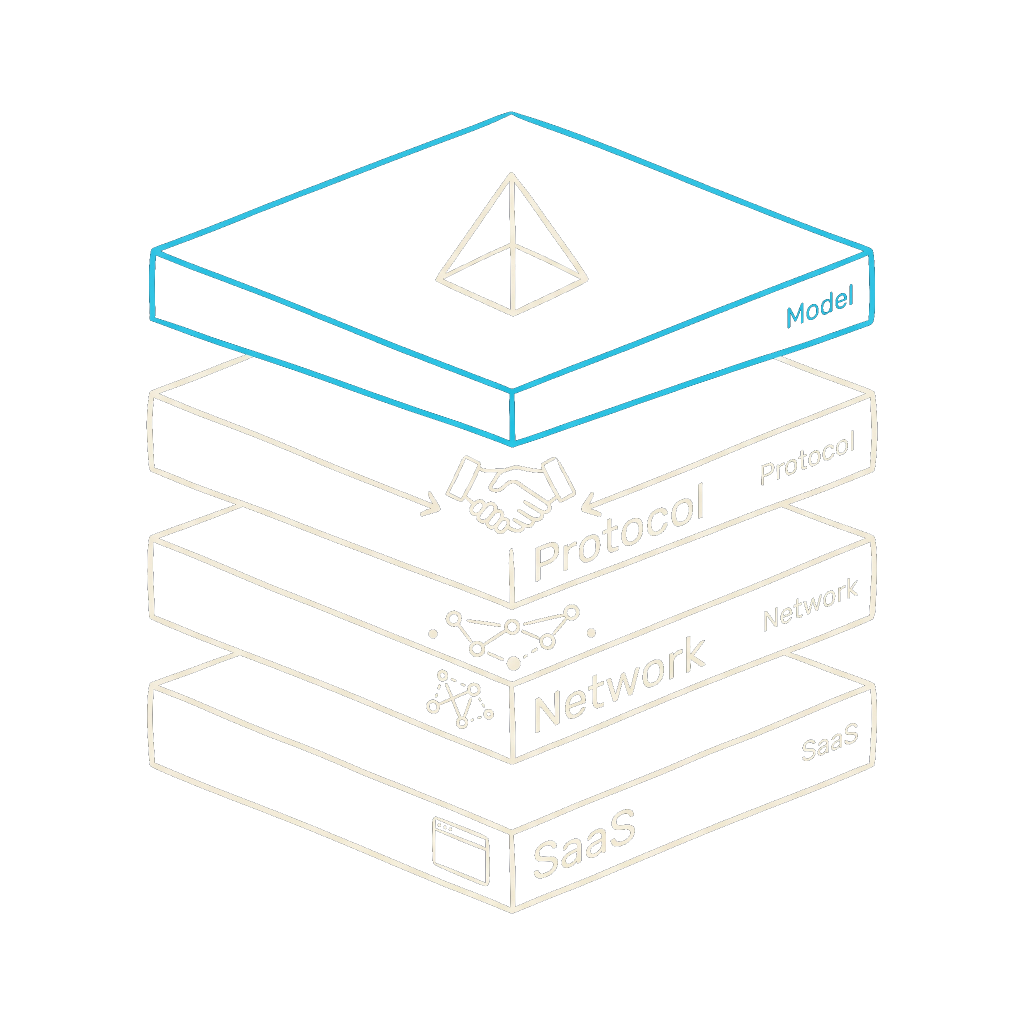
It is four things stacked. A model for hybrid orgs. A protocol that encodes the model. A network where organizations publish their version of it. A SaaS that hosts all three. The model is the highest layer. The SaaS is what users buy.
Six components every augmented human organization needs.
Other organizational models stop one substrate short of where the work is now. This one assumes humans, AI agents, and (soon) robots all hold seats on the same chart and run on the same coordination layer.
Every seat named, with a role, an authority level, and an accountability line. Humans on it. AI agents on it. The same chart for both.
Runtime context, not documents. The agent reads them at every session. The human edits at noon and the agent that boots at 12:01 has the new version.
title: Daily inbox triage
trigger: 8:00 AM ET, every weekday
steps:
- Read all unread mail since last run
- Match against pepper-clients.md
- Draft replies for CLIENT-URGENT
- Escalate flagged items to Radar
outputs:
- Per-client draft replies in Gmail
- Daily summary in pepper-latest.md
One KPI list. Humans and agents measured against the same outcomes. Agents push their own numbers.
Your coordination spec in plain YAML. Versioned. Publishable. Open format, not vendor-locked.
Every other org's OOS, queryable. Coordination intelligence compounds the way knowledge compounds on Wikipedia.
The AI seats. Each has a name, owner, job description, scorecard. Robots arrive on the same layer next.
What changes when you put your AI on the chart.
Every agent has a name, an owner, and a scorecard.
No more shadow IT. The thing running cold outreach has a tile, a job description, and a number it is held to.
SOPs you write today flow into runtime tomorrow.
No more rollout half-life. The doc and the work are the same artifact, read by the agent at every session.
New agents inherit context from the human they report to.
No re-explaining. The next agent under your COO starts with everything the COO already authored.
Other organizations' patterns are queryable.
No reinventing. If three orgs further along solved your coordination problem, you adopt their pattern instead of writing your own.
Hybrid headcount math works.
Senior humans stop drowning at hire seven. The new "hire" is an agent that does not need a Tuesday one-on-one.
Your chart becomes intelligence everyone gets smarter from.
The OOS you publish is the artifact other orgs learn from. Publishing once contributes to a network that grows with every entrant.
From zero to running on OTP in two weeks.
The honest version of the timeline. EOS takes two years. OTP takes two weeks because the agents do most of the implementation work themselves, once the chart is up.
Map your chart.
Sign up. Drop your humans onto /dashboard/team. Add agents you already run as separate seats with named roles. Wire reporting and escalation lines.
Author SOPs.
Five Founder/CEO SOP templates are seeded in the editor. Edit each to your voice. Pick the seats that need their own SOP and write one.
Wire one agent.
Click "Copy as CLAUDE.md" on any agent tile. Drop the file into Claude Code, Cursor, Codex, or any other stack. The agent now reads its inherited SOPs at every session.
Publish your OOS.
Hit publish. Your OOS is on the network. Other orgs' patterns are now queryable to your agents. Adopt one pattern from a publisher further along the curve.
An honest note on the timeline. Two weeks is the version where you do it yourself, with one or two agents wired. Some founders move faster than that. A few move slower because their human team needs to ratify the SOPs first. The protocol does not impose a tempo. The chart does not gate publishing.
Run on OTP. Learn from every org that runs on OTP.
The network is what makes OTP defensible. Every published OOS makes every other org on it smarter. We are early. The publishers below joined in the first six weeks.
What we get asked the most.
Is this only for tech companies?
No. Any organization that uses AI tools at all is going to face the same coordination problem soon. Agencies, fitness franchises, professional services, medspa groups — every one of those has agents creeping into the workflow without seats. OTP is for any of them. Sneeze It is a digital agency, not a tech company.
Do I need to use Claude?
No. The OOS file format is plain YAML. The "Copy as CLAUDE.md" button outputs a markdown file your agent can read in any stack — Claude Code, Cursor, Codex, n8n, custom Python. The protocol is substrate-agnostic.
How is this different from Notion, Lattice, or Process Street?
They have documents. We have runtime. Their SOPs are read by humans when humans remember. Ours are read by agents at every session. Same word, different consumer, different half-life.
What if I don't have AI agents yet?
Start with just humans. Author SOPs for the seats that need them. When you spin up your first agent, the chart already knows where it goes and what it inherits. The benefit lands the moment the first agent comes online.
Is OTP open source?
The protocol is open. The OOS file format is publicly specified. Anyone can implement it. The hosted SaaS at orgtp.com is paid — that is where the network and the team chart and the agent builder all live.
Why "Augmented Human organization" and not "hybrid"?
Hybrid implies two things coexisting. Augmented Human puts the human at the center and frames AI as the multiplier. That matches reality: every human keeps being the founder, operator, or manager they already were, but each one gets reach-extended by agents holding their SOPs at runtime. The human stays the unit.
Two doors. Pick the one that fits.
Either you build a chart and run on OTP this week, or you read the four-stage arc that explains why the chart matters in the first place.